
Article: How to Build a Whiskey Library at Home
How to Build a Whiskey Library at Home
A whiskey library isn't a bar. It isn't a man cave, either — that word implies retreat, a place to hide from the rest of the house. A whiskey library is closer to a study that happens to serve pours instead of only books: a room built around slowing down, not performing for guests or announcing what something cost.
Most people start in the wrong place. They buy a bottle worth talking about, then realize the room around it doesn't hold up its end of the conversation. Building the room in the right order changes that.
Start With the Seating, Not the Bottle
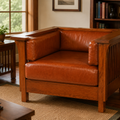
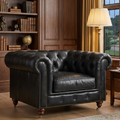
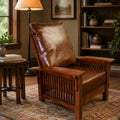
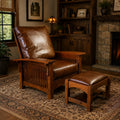
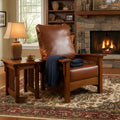
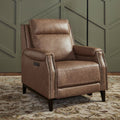
Before anything else, decide what the room is actually for — and that means deciding this before deciding how many chairs. A whiskey library built for solitary retreat wants one great chair, positioned to face a window or a shelf, not a doorway. A whiskey library built for a smaller, closer kind of company — the friend you can actually talk to, not entertain — wants two chairs, angled toward each other rather than aimed at a screen. Most people don't choose; they end up with three or four chairs that serve neither purpose particularly well.
Whichever you choose, the same principle holds: everything else in the room exists to support that seating. The side table within arm's reach, the lamp that lights the glass without lighting the whole room, the rug that keeps the space from echoing.
Skip this step and you end up with a room full of good pieces that don't add up to anywhere you actually want to be — alone or with someone.
Give the Room Somewhere to Keep Its Things
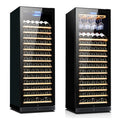
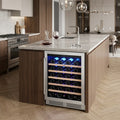
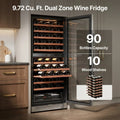
A bottle standing alone on a shelf reads as clutter. A bottle inside a cabinet built to hold it reads as a collection. The difference isn't the bottle — it's whether the room was designed to display it or just happened to end up near it.
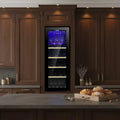
This is where most whiskey libraries either come together or fall apart: a proper display cabinet or back bar gives the room a visual anchor, the way a fireplace anchors a living room. Open shelving works too, but only if what's on it was chosen deliberately — three bottles arranged with intent beat fifteen crowded together every time.
Light It Like You Mean to Stay
Overhead lighting is the fastest way to turn a whiskey library into a waiting room. The rooms that actually get used are lit low and warm — a single lamp, maybe two, positioned to pool light where the seating and the glass are, leaving the rest of the room in soft shadow.
This isn't just aesthetic. Warm, low light is doing real work: it's the visual cue that tells your body to slow down, the same way dimming the lights before bed does. A room lit for browsing and a room lit for staying are not the same room, even with identical furniture.
If Cigars Are Part of the Ritual, Respect Them
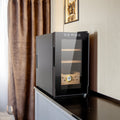
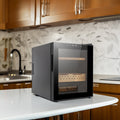
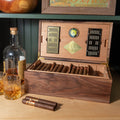
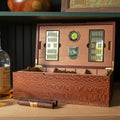
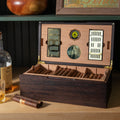
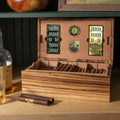
A humidor isn't decoration — it's the only thing standing between a cigar and ruin. Getting the humidity and temperature right matters more than how the cabinet looks, though the good ones manage both. And if cigars are a regular part of the room, air quality stops being optional; a space that smells like an ashtray the next morning isn't a library, it's a problem waiting to be solved.
This is usually the piece people underinvest in first and regret last.
You Don't Have to Discover the Order Yourself
Everything above is really about one thing: sequence. Seating before storage, storage before light, light before the finer cigar details — get the order right and the room comes together; get it backwards and you end up with expensive pieces that don't add up to anywhere you actually want to be.
Working that sequence out alone, piece by piece, can take years — and plenty of rooms never get past the first two steps. That's the real case for a curated collection rather than a pile of individually excellent items: the sequencing is already solved. A Signature or Reserve room isn't just more furniture — it's a set of pieces already chosen to work together, in the order that actually matters.
We're building The Retreat around exactly that idea — the sequence already considered, whether you're starting with one chair or a complete room.
If that's the kind of space you're building toward, join the waitlist below to hear when the first pieces are ready.